Monday, November 8, 2010

Last Day of the Show

On Sunday, the last day of the show, both Rose and Pocahontas were up in the ring.

Rose showed in a class of 2 juvi rose grey female huacaya alpacas. We would have hoped for more competition, but knew that the fall often has smaller juvi classes. Most farmers breed for animals to be born between May and October, so those animals are now all over a year old and in the yearling class, or less than 6 months and too young to show. Rose came to our farm this spring, after being born in April. We do not typically breed for an April birth, so we typically would not have a juvi to show at this point either.

The judge placed Rose in 1st place! She had nothing but great things to say about Rose, including the fact that her light and dark fibers, making up her grey color, is very uniform. She has great uniformity, and consistency throughout her blanket, and has very dense fleece. The only negative is that Rose has some tender breaks, due to recent weaning from her mother. This was also a factor with the other juvi in the class so did not effect her placing. However, it was a consideration in the color championship.

When we get our professional picture of Rose and her ribbon I will be sure to get it up here on the blog and on our farm's facebook page. Rose will join our Hall of Fame of 1st place ribbon winners, along with Sancha, Kateri, Shelby, Tehya, Pocahontas and now Rose. Girls rule :)

Pocahontas showed in the Indefinitely Dark class of yearling huacaya female alpacas. Originally she was the only one in her class, but when we got there to line up to show her, there was another animal in her class. We welcome the competition, and were happy to see another animal to go against. Unfortunately Pocahontas got 2nd place. We were very disappointed about this. The reason the judge gave is that Pocahontas is at an awkward growth place and wasn't as rock solid in her conformation as she'd like to see. She also said that Pocahontas' fiber lacked luster. This was the most disappointing because I stopped giving her fiber nutrients. I just know that is what made this difference. Needless to say, we are giving fiber nutrients again, already started with today's feeding. Some things are not worth skimping on. We have decided that this will be Pocahontas' last show. We are retiring her from the show ring. Over the next few months were are going to give her plenty of fiber nutrients, and get her healthy and vibrant so that we can breed her in the spring. We likely will breed her just after shearing in May. We cannot wait to see the animals she can produce. Pocahontas has been our best award winning alpaca, she has done us proud.

Here is a really bad picture of both girls in the pen at the show:

Saturday, November 6, 2010

Fall Show - day two

Today, Saturday, is the day that actual alpaca showing began.

Alpacas are broken up into classes by type of alpaca (Suri or Huacaya), by age (juvi, yearling, 2 year old and Mature), by sex (male or female), and by color. All of our alpacas are Huacaya. Rose is a juvi (older than 6 months old but younger than a year old). Pocahontas and Cavalier are both yearlings. Just after you arrive, you bring your animal to "color check", this is where they verify the alpaca's color to make sure they are in the right class.

Cavalier color checked as "medium fawn". This put him in the class of Huacaya Yearling Male, Medium Fawn. There were 17 total in this class, so it was split into two groups. Cavalier placed 4th in his group of 9. Cavalier is one alpaca that we have had a hard time evaluating ourselves. We struggled with the fact he has some primary hairs that stick out, and his chest is smaller than we would ideally like to see, but we were not sure how this would affect his placing. The judge stated that Cavalier had great proportions, great brightness, great density and fineness. The only fault the judge stated was that Cavalier he has inconsistency in his micron, which is the same issue as the halo of primary hairs. Cavalier's placing is about what we expected. It feels good to know we already had identified what issue might be a problem for him in the ring.

As my long time readers will know, I don't take pictures of the alpacas in the ring. I used to, but I found whenever I did this they did terrible. The times I forgot my camera, they would do well. Now I just don't do it at all, I leave the camera alone until after they show.

Here is Cavalier's ribbon:


Right when he got back to his pen, he started eating hay. I swear they stress eat:


Finally I got a picture of his face:


Rose colored checked as rose grey. She is in a class of 2 alpacas, both huacaya juvi female rose grey. There are rules about combining classes and separating classes. For this show, they separated the silver grey from the rose grey. Some shows choose to put these classes together. Because they are separated, the class is small. While a positive to having a class of only 2, you are guaranteed to get a 1st or 2nd place. But, we like the competition, we want to know how our animals measure up, even in a big competitive class. So, we are not happy to have her in such a small class. Rose is an incredible animal, she needs to show off her great qualities. I do have to say whenever we walk her anywhere we get comments from people passing of how cute she is and how they want to take her home. Rose will show on Sunday.

Pocahontas color checked as Indefinite Dark (we had the judge double check because she's a tricky one). Indefinite Dark is a last resort class for colors that don't fit into any other category. Pocahontas is brown with grey fibers throughout her blanket. She really is a rose grey without enough grey to be considered grey. Unfortunately, she is the only one in her class at this show. This means she has no competition. In a case like this, the judge usually awards the animal a 1st place, but also gives an evaluation of the animal. Sometimes, the judge will decide the animal has enough of a fault that a 2nd place is awarded. Being that Po has won 1st place in groups of 2 and 3, we would be very surprised if there was a fault so great that they only awarded her a 2nd place. Tomorrow we will find out for sure.

Over all our trip has been good. We have found some great restaurants (after our horrible time in Columbus, Ohio, not being able to find good places to eat, we have a new respect for this). The hotel is wonderful, except for the train tracks right behind our room. I didn't notice the train going through, but J reports it seemed like a train came by every half hour all night long. Needless to say, we won't stay here if we come to this venue again. Though I have enjoyed the high speed internet and the hot tub.

Sunday will be a busy day for us. We would like to get to the show early enough to see our former alpacas, Lightning and Lily, show in their white classes. Whites are showing first thing in the morning. We are eager to see how they do. We will need to show both Rose and Pocahontas. Then we will begin to pack up and eventually head home.

Old Friends

We were excited to run into 2 animals that were born on our farm, but now reside on other farms. Both of these animals came out of our girl, Sancha, so they are half-siblings.

Lightning only left our farm a couple of months ago, though he seems to have grown since we last saw him:


Lily left our farm in March, so it's been quite awhile since we've seen her. She's changed a lot! She looks a lot like her mother.


Her owners showed us a color banner that she won! We are so impressed with such an accomplishment. She came from our farm, so that gives us bragging rights on this:

Friday, November 5, 2010

Fall Show - day one

We packed up and left the house in record time this morning. I dropped the kids off at school at 8 a.m., and before 9 a.m. we had the alpacas ready, and were on the road. Here is our truck and trailer ready to pull out of the driveway:


This is our first time attending Alpacafest, and it's the first time we have been to this venue. We did not know what to expect. The stalls are different than any we have used before, they are tall horse stalls, not our typical movable pens that we've been familiar with. This meant we had to adjust how we set up our pen. Here it is mid-set up when everything is still out of place:


We eventually got everything in it's place. Unfortunately the way the stalls are, the alpacas can hardly be seen. I can't say I like the set up for that reason alone. We want to show off our animals, we want people to see them from far away. You can't see them at all here:


Our alpacas do have hay to eat in the trailer their entire ride, but they always seem to dig right into the hay right upon arrival. I think they stress eat:


Here they are eating their grain:


I am leery about the show rings too, we have never shown in a dirt arena:


A lot of things are different about this show than what we have been used to, not only the stalls and the show rings, but the entire venue. I am trying to keep an open mind, but I admit, when we first arrived I was a bit disappointed. Maybe if we win some nice ribbons that will change my mind.

The first day is only the set up and the exhibitors meeting (which did not get over with until almost 9 p.m.!). Saturday they start showing at 8 a.m. We do not have any animals in the first few classes. Likely only Cavalier will show, late on Saturday. Sunday both Rose and Pocahontas should show.

Heading to Alpacafest

This weekend we are taking three of our alpacas to Alpacafest in Springfield, Ohio, at The Champion Center Expo. Going to alpacas shows is fun for several reasons. Of course it's nice to bring your alpacas to show them off. You hope for great ribbon placing. Not only does that give you bragging rights, but everyone wants their alpaca to be the best in their class. But this isn't the only reason to go to alpaca shows. We find we learn so much at shows. We would not be where we are, producing the quality alpaca we are, without the incredible knowledge we have learned at shows. Not only do you get the judge's feedback on your alpacas, but other alpaca owners are a wealth of information. So many alpaca farmers are welcoming of questions and willing to share their knowledge. We also love catching up with fellow alpaca farmers. Over the years we've been going to shows (over three years now), we've developed friendships with various farmers all over the country. It's great to have a chance to see everyone, even if it is only a few times a year. It's also nice to have a weekend away from the farm, away from the regular routine.

It is a lot of work to go to a show though. You have to make sure you have someone to watch the alpacas left at home. This time we are leaving our 11 year old in charge of the entire farm care. While that seems like a tremendous job for an 11 year old, let me add that she's a very responsible 11 year old. She's been feeding the male alpacas twice a day for several months. She knows how to do the routine with the girls. And I know I've mentioned she can lift a bale of hay on her own. She's tough. And there will be grandparents around if she does need help.

It's also work to get the alpacas ready to go. We are taking OHVNA Pocahontas, OHVNA The Cavalier and Enlightenment's Rocky Rose.

As a juvenile, Pocahontas won 1st place twice, once she also won Reserve Color Champion. This was our first color banner, a huge accomplishment for us. Both 1st places were at level IV shows. She also won a 2nd place (level IV show) and a 3rd place (at Nationals, a level V show). We are curious to see how she will do in the show ring as a yearling. My biggest concern about Pocahontas is that she has lost her cute juvi look. She had a fluffy face and a very cute look to her. Her top knot is not full and incredible like I want it to be. But when you dig in her fiber, that luster, bundling and crimp is still there. If it were a fiber only contest, she still has it.

Pocahontas as a cute juvi:


And a more recent photo of her:


Pocahontas' fiber:


Cavalier was one that I almost didn't show as a juvenile. He was a bit on the smaller side, and I felt that while his fiber had great crimp and character at the root, it fell out near the tip. We did cria shear him, but we did it too early on, so it didn't get all the cria tips off. I said all along I expected he will do better as a yearling. We will see if that prediction is correct. Cavalier feels very dense, has good fineness, and incredible character to his fiber crimp and bundles. What he lacks may be size, his chest is a bit smaller than ideal. We will see how that places him in the ring. Last year we did not take him to as many show due to believing he will do better as a yearling. As a juvenile he received 4th placed at a level IV show in a very large class.

Cavalier (I love his big bushy top knot, he is a pretty boy for sure):


Cavalier's fiber (this is last year's shearing, so does include those cria tips, now the entire length looks like the base of this example):


Rose is a juvenile, and this will be her first show, she only just now turned 6 months old. While I know there is always the risk of being barn blind - so in love with your animal that you miss their faults - I don't think this is the case with Rose. I think Rose is the best animal on our farm. To evaluate an alpaca, two things need to be considered: their confirmation and their fiber. Conformation is things like a straight back, legs at the right angles, neck in proportion to body length, and how their teeth line up. Rose is straight and fits in the rectangular box perfectly. The other factor is fiber. Rose's fiber has consistent crimp with bundles throughout her blanket. While alpacas are not judged on their color, it doesn't hurt her at all that she has a wonderful lovely lavender rose grey color.


Rose:


Rose's fiber:


Shows are run in order of color, starting with black, then brown, fawn, and white, then into the greys and indefinites. Cavalier being fawn will be the first of ours to show. But he easily may not show until Sunday morning. This means most of Saturday we will not have much to do at the show. It will give us a chance to walk around and soak up all the information we can. Rose will show after Cavalier, she will be in the grey class. As a juvi Pocahontas showed in the Indefinite Dark class, she didn't have quite enough grey fibers to be considered grey. She has more grey fibers now, but we aren't sure if there are enough yet for her to be in the grey class. If she is grey, she could show right after Rose, as Rose will be in the juvi class and Po in the yearling class.

We are anxious to see how each of our animals do at the show this weekend.

Wednesday, November 3, 2010

End of the hiatus

After a bit of an unplanned fiber hiatus, I got myself back at the spinning wheel to finish up a skein of Rosco's fiber. I'm eager to knit this up into a scarf, but I fear J will snatch it up before I have a chance to do that.

Monday, November 1, 2010

Boys Update

Last week when we did herd health, we decided it was time to trim up the boys top knots. While I love a big, full, long top knot, it's not the easiest to maintain. We have the added issue of quite a few burrs in our hay. While the burrs are a huge pain, the hay is great otherwise. So, we trimmed their top knots a little shorter than we have in the past, in order for easy of maintenance. I was surprised how well I liked the new look of the top knots, they turned out really well (ignore the time date stamp on these pictures, I used Emma's camera and it wasn't set right):


We also decided it was time to wean Copper. At five months old, he's 82 pounds! Typically we look for around 100 pounds at a year old. He'll be 100 pounds in no time. We go by the rule of thumb to wean around 6 months old and 60 pounds. We did wean Copper a little on the young side, but he's so big, and his dam (mother) has always struggled with keeping weight on. Weaning will help his dam put on the weight she needs to birth her next cria. Copper is eating grain and hay well, he doesn't need mother's milk anymore. So, we brought him up to the little boys barn. Here is Copper with Snowstorm and Cavalier:


We had Cavalier and Georgio in that barn together. We weren't sure how this arrangement would work with Copper. Cavalier is just over a year old, and not that big, but Georgio is an older breeding male. When we put Copper in there, we decided this wasn't going to work with Georgio. So, we moved Georgio in with the big boys. We had kept him with Cavalier so that Cavalier had a friend, and because the Georgio is a bit smaller of a male, and our big males were pretty rambunctious. We've had some changes in our big boy barn (such as Navigator going home and Tucker coming back and Lightning leaving), so the dynamics there are much different. There has been a lot less fighting. Georgio is actually about the same size as Greyt and he holds his own in that pen. So far this move seems to have worked well. Here is Georgio and Cavalier greeting each other over the fence now:

Sunday, October 31, 2010

Growing alpacas and herd health confessions

When we did herd health, we weighed our alpacas who are 2 years old and under. Here are their stats:

Eclipse' Ginger Ale (1 month old) ~ 27.4 pounds


OHVNA The Challenger (3.5 months old) ~ 48.2 pounds


OHVNA Chaska (3.75 months old) ~ 62.0 pounds


Smokey's Twilight (4 months old) ~ 55.4 pounds


Our Copper Canyon (5 months old) ~ 82.0 pounds
(the small brown one is Copper):


Enlightenment's' Rocky Rose (6 months old) ~ 78.0 pounds


Ashton Stones Little Miss Rosco (1 year, 2 months) ~ 111.0 pounds


OHVNA Pocahontas (1 year, 4 months) ~ 100.6 pounds


Kateri's Tehya (2 years, 3 months) ~ 152.8 pounds


Our guide for alpaca weights is that most of ours are born between 16 and 22 pounds, by 6 months we'd like to see them around 60 pounds, and by a year at 100 pounds. Grown adults can be anywhere from 100 to 230 pounds. Most alpaca farmers prefer not to breed an alpaca until they are 120 pounds, that's about when maturity seems to be reached. We have some that are on the smaller side, some that are bigger. Outside of a medical issue, size is a purely a matter of personal preference. I actually like the ones that are a bit smaller. For example, Victoria is my favorite phenotype and she is around 130 pounds. Greyt is another one that I would say is my favorite size, and he's around 140 pounds. We have other grown alpacas that are 200+ pounds. I know some people prefer the bigger sizes, it really comes down to what you personally like. In the end, it's really the fiber that counts, not the size of the animal. We only monitor their size to make sure they are healthy and thriving like they should be.

My herd health day confession is that today Lucy managed to throw and stomp on me. Alpacas are not typically aggressive, this only happened because I was restraining her so that J could clip her nails. Lucy is new to our farm, and this is the first time I have restrained her. She's a big girl, and very strong. J clipped 2 of her nails, while I wrestled with her to keep her still, then she suddenly jumped up. She bucked me in the chest and I went flying into the air and landed on my back. I don't know what happened to my leg. I don't know if my ankle twisted around or she stomped right there on me, but my leg instantly hurt very bad. Thankfully she was the last alpaca we needed to care for, because I limped inside and now have ice on my leg. I suspect by morning I will not be walking very well.

Frosty morning

This morning I woke up to a light frost covering everything outside, including the alpacas. Our thermometer shows a low last night of 25*F. Most of the alpacas choose to sleep outside, they don't seem one bit bothered by the frost on their backs.

Here is Victoria and Snickers' frosty backs (with Lucy's head in the background):


It's much harder to see the frost on the lighter colored animals, here is Latte and Sancha:


I knew it got cold last night. After getting home from taking the kids trick or treating, Spot got loose. I had to chase him down the driveway in the dark. Thankfully he wasn't too hard to catch this time, but it was sure was dark and cold out there.

This morning he was very sweet and apologetic:


Friday, October 29, 2010

Growing Cria

Ginger has been growing by leaps and bounds. She is outgrowing her cria coat:


We generally use the rule of thumb that any cria until 40 pounds, if it's under 40* needs a coat on. It seems to be working, cause she's growing and thriving. Though she's still a baby:

Thursday, October 28, 2010

Faces

The baby face of Ginger (I can't believe how much she has grown, she is outgrowing that cria coat):


The burr filled face of Rosco:


The cute macho face to Chaska:


Challenger's colorful face:


Lucy's face is the one who always greets me first:

Wednesday, October 27, 2010

Oak Haven Leaves


Our farm is named Oak Haven due to the fact our alpacas live in a haven of oak trees. This means we have a ton of oak leaves. I remember when we first were researching alpacas, I read how the tannins in the oak leaves are toxic to alpacas. The first year they were here, we diligently raked every pasture area free of leaves. It was so much work, but we were sure we had to do this. Now, three years later, we've come to the conclusion that while the oak leaves may have some toxic effect, it would take a lot of oak leaves to create such a scenario. Alpacas much prefer to munch on their hay. As long as we have plenty of hay for them to graze on, they only eat the very rare oak leaf. The leaves would never make up the majority of their diet (which is what it would take to reach even close to toxic levels). They are more likely to eat fresh green oak leaves, than the brown ones that fall this time of year. I do make sure leaves do not clog up their water buckets, as that would leach out the tannins into their water.


Over Tuesday and Wednesday we had a pretty significant wind storm blow through our area. This made many more leaves blow off the trees. I was worried how many branches might blow down on the alpacas. Thankfully no damage was done. The trees are wonderful to provide shade in the summer, shelter from the wind in the winter, but not great for leaves in the fall, and broken branches in a storm.

Here is how bare the trees got after just one day of wind blowing (these were taken on Tuesday evening):


Tuesday, October 26, 2010

Dog shearing?

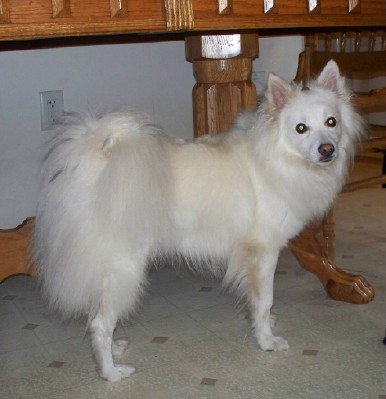
I said I was against it, but we did it anyway. Our house dog, Quinn, is a pure bred Miniature American Eskimo. His breed is supposed to be brushed everyday, not shaved down. When we picked him out, back when he was a puppy, he was so cute, I was just sure I could brush him regularly. Well, that didn't last long. Here he is, just over 2 years old, and leaving massive amounts of long white hair all over our house. He has the most wonderful personality, but the hair, I was vacuuming the house three times a week and still not keeping on top of it. The thought of him living another 12+ years and dealing with his hair all this time was too much. We came to a cross roads, something had to be done. Even though you aren't supposed to, we decided to shave him down. I've read that because his breed has two layers of fur growing in, shaving it down can mess up those layers so it never looks good again. Well, we can just keep him shaved down so we won't have to worry about how it grows back.

J ordered a dog grooming kit, and this weekend we sat down to shave Quinn. I held Quinn, J used the shaver. I have to say, Quinn behaved better than I thought he would. The shaver on the other hand, did not work as well as we thought. It may be because Quinn's fur was so long, it's so fine, and it wouldn't stay in the guard to be cut.

Here is Quinn before:


Quinn with Shadow before (just like black alpacas, black dogs are very hard to photograph), our two house dogs:


Here is Quinn after:


We have no plans to open up a dog grooming salon. But I am excited to think about less dog hair floating around my house.
Pin It button on image hover